
Hiring A New Strategist Every Morning
Ried Watkins - August 2026
Every morning, we hire a new strategist.
They are quick, tireless, and better read than anyone on staff. They also have no idea who we are. Not our clients, not our methods, not what happened here yesterday. So before they can do anything useful, they read:
· what we are trying to accomplish
· what the landscape looks like
· what has already been tried
· what we learned when it didn’t work
· how S.I.R. writes and thinks and argues.
Then they get to work, and the work is good. In some cases, spooky good.
At the end of the day, they write down what they learned. Then they’re gone. The next morning, we hire another one.
This is how today’s AI agents work, and it’s how our team runs them.
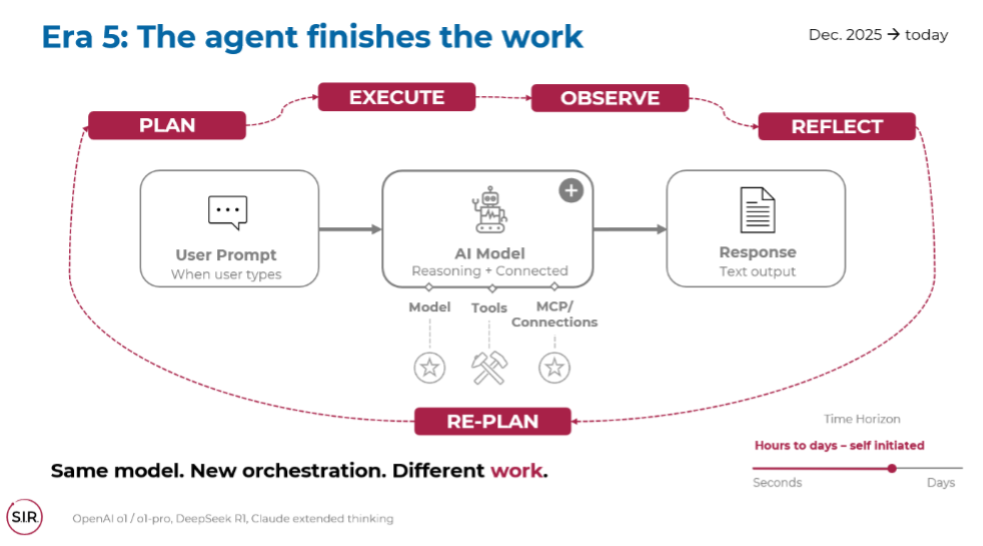
Much of what we do for our clients – research, analysis, strategic planning, communications – is data transformation. We collect information, work it over, find what actually matters inside it, and hand it back in a form somebody can act on.
Data transformation is also a fair description of what a large language model does all day. Text goes in, the model does its thing, and more useful text comes out.
It’s no surprise then that these fresh recruits can immediately tackle deeply complex, technical analyses in their first few minutes on the job. It’s also no surprise that we’ve been reading analyses for the last 3 years saying that AI is coming for our jobs FIRST.
What might actually be surprising is that we’re more excited and confident in our craft, and value to our clients, than ever before.
What’s Actually In The File

The thing that makes our agents useful is not the model. It’s a set of plain text files.
They hold the objectives, the state of the environment, what has been done in it before, the lessons learned when something failed, the roles and standards and voice of the firm. Each time an agent finishes a task or turns up something worth remembering, it writes back to one of them. Over months, these accumulate into a dense, specific, hard-won account of how work gets done at S.I.R.
We take them seriously. They get cleaned, pruned, and reconciled when two of them disagree, and rewritten when they sprawl. Making them coherent across teams and across agents is an ongoing project with no obvious finish line. It is, without much competition, the highest-leverage work we’ve done with this technology.
And it is still onboarding, not true experience.
A briefing is not a career
Here’s the rub that we’re experiencing first-hand. A knowledge file gets longer, more detailed. A person gets better. Those are NOT the same thing.
When one of our agents learns something on Tuesday, that lesson becomes text. On Wednesday, a fresh instance reads the text. Nothing about the model changed. Its judgment wasn’t revised, its instincts weren’t sharpened, and its sense of which clients want the argument laid out versus which ones want the number and nothing else didn’t improve. It read a better briefing. It was a better temp for having read it.
This is easy enough to test yourself. Hand a model the same document ten times and ask what it learned, and you get ten versions of the same answer. Nothing compounds. There is no equivalent of sleeping on a hard problem and finding it quietly rearranged by morning.
No, seriously, we think our agents may actually need some kind of sleep. Engineering write-ups on agent memory now describe an optional “dreaming” pass that runs once sessions end. What it does is consolidate notes, drop stale entries, and link related ones. Useful work. It is also filing, not learning. The model that wakes up is the same model.
What doesn’t fit in the file
What one our directors or managing partners walks into a room with isn’t just recall. It’s an instinct on which of the client’s stated problems is the actual problem. On when the data is telling you something real and when it’s telling you the question was badly worded. On which recommendation their team can absorb without choking on it. Michael Polanyi had a phrase for this: we know more than we can tell. Some of it can be described after the fact, but it’s usually hard to transfer from person to person.
Organizations are many things, but they’re mostly people. Most of their problems are people problems, and those are really hard to encode in a couple plain text files. Even our most sophisticated agents are nowhere close to being ready for a board meeting, focus group or workshop session with real people.
Which is why we’re more excited than ever about our future. Somebody has to decide what goes in the file, what gets cut, and which of two contradictory entries was the one that turned out to be right. That somebody has to already have the judgment. The file is downstream of expertise.
A little daydreaming
We’ve thought a lot about what would change our answer.
Not a larger context window. That’s a longer briefing. Not better retrieval, which is a better-organized briefing. What would change our answer is an agent that finishes a Thursday and comes back Friday actually different. Not having read about Thursday. Changed by it. One that accumulates, across a year inside our environment, something resembling a feel for our clients and our work. At that point we wouldn’t be onboarding a temp every morning. We’d be mentoring a real member of our team, one with an incredible career ahead of them.
That capability doesn’t exist today, and the people building these systems treat it as an open research problem rather than a feature on the way. So for now, every morning we hire a new strategist. They read what we left out for them, they do excellent work inside the boundaries we drew, and they go away. And every morning, a person on our incredible team decides what they need to know.
S.I.R. spends a ton of its time now on the reference layer that makes AI agents useful inside a real-world organization, and where that layer stops. In our experience, the boundary between the two is jagged and always shifting. Exploring and building on that frontier for ourselves, and our clients, is what gets us out of bed in the morning and powers a sense of wonder and optimism about where all this is headed.