
Intelligence As Infrastructure
What the history of energy teaches us about the buildout underway,
and the problems nobody has attempted yet.
Ask most people what artificial intelligence is and you get some version of the same picture. A chatbot. You type a question, it types an answer. Summarize this email. Write a birthday card for your aunt or a funny poem about George Washington. A novelty. That's been the story since ChatGPT launched in November 2022. Or it was, until some point in late 2025, when it suddenly wasn't.
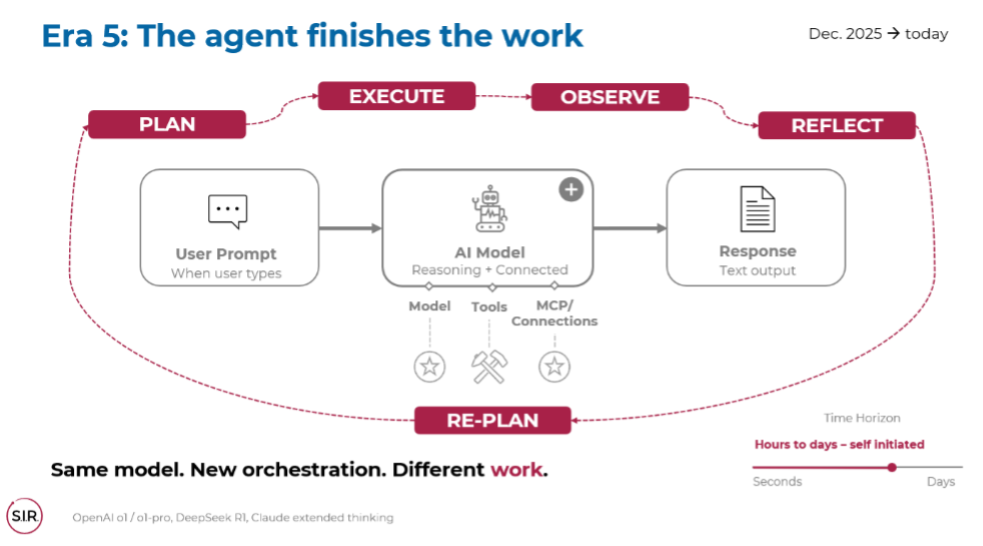
The models did get better over that stretch, but the larger change happened around them. These systems can now reach tools, carry memory across a long task, plan, act, check their own results, and retry when something fails. The industry calls this the agentic era. In practice it means you can point one at a real problem and it will work against that problem, through trial and error, step by step, until it finishes or fails in a way you can see.
That's not how software acts. That sounds more like a utility, like water, gas or electricity.
Electricity does not care whether it turns a motor, lights a room, or runs a transistor. You generate it, you move it, and you put it to work on whatever needs doing. Digital intelligence is starting to behave the same way. The work it happens to do is cognitive.
If that's the case, then the history of energy has more to teach us here than the history of software.
Including some episodes we would rather not repeat.
Questions unasked and problems unattempted
To build anything you need three inputs. Raw materials, energy, and minds to make the decisions and direct the work. When one of the three runs short, that's your bottleneck on what gets built.
For most problems worth solving, the binding constraint has not been materials or power. It has been the number of capable people we could put on the problem.
Consider a town of four thousand people whose water system has been failing for a decade. There is federal money appropriated for exactly this problem. Getting it takes a needs narrative, three years of audited financials, a preliminary engineering report, and a benefit-cost analysis. Probably a month's worth of work by someone who has done it before. Unfortunately, this town has a part-time mayor and a clerk who also handles utility billing. The application doesn't get rejected. It never gets written.
According to the Government Accountability Office [link to GAO source], only about 5 percent of rare diseases have an FDA-approved treatment. The ingredients or importance aren't what's keeping that number so low. For most of those conditions, no team was ever assembled, because getting the right people on the job was a cost no one could afford to take the risk on.
We tend to sort problems into two piles, solved and unsolved. There is a third pile, larger than the other two combined, holding the problems nobody has attempted because attention has always been expensive and there has never been enough of it to go around.
What energy can teach us
The relationship between energy and prosperity is one of the most durable correlations in economics. Our World in Data [link] plots energy use per person against GDP per person for every country on earth. No rich country uses little energy. No poor country uses a lot.
We're not economists, but this chart basically explains itself: Access to energy drives growth. It's why energy access has (and continues to) set the terms of the last century's geopolitics.
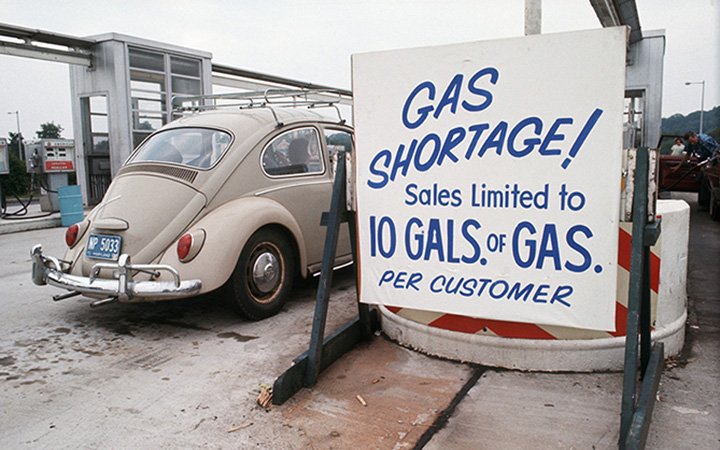
In October 1973, a group of oil producers on the other side of the world (OPEC) made a decision about oil supply. Within weeks, Americans were sitting in lines at gas stations, costs were spiking, and many were realizing their economy was bottlenecked on an input we did not control.
The bottleneck to the bottleneck
Producing digital intelligence means converting electricity into thought. That is nearly a literal description of the process. A data center takes in power and puts out answers.
The industry has already reorganized its vocabulary around this. Capacity is quoted in megawatts rather than square feet. And that is exactly where the true bottleneck is. A trained model can be copied for nothing. A million people can use the same one simultaneously and none of them gets less than the other. The recipe is free. Every serving costs power, and the power has to come from facilities that take years to build.
That build time is everything today. Large power transformers now carry lead times of two to four years. In PJM, the grid operator covering Virginia, projects that reached commercial operation last year had spent an average of roughly eight years waiting in the interconnection queue. So even if we go hog wild building new power plants, we’re several years out from seeing any tangible benefits.
We have no doubt that Americans want and will demand access to digital intelligence. It’s a major input for growth the country desperately needs. The questions is whether that access runs through capacity built here, under American standards, reachable by Americans. Or will we access it through capacity built somewhere else, on someone elses terms, and ignore the lessons history has taught us?
Early Innings In A Long Game
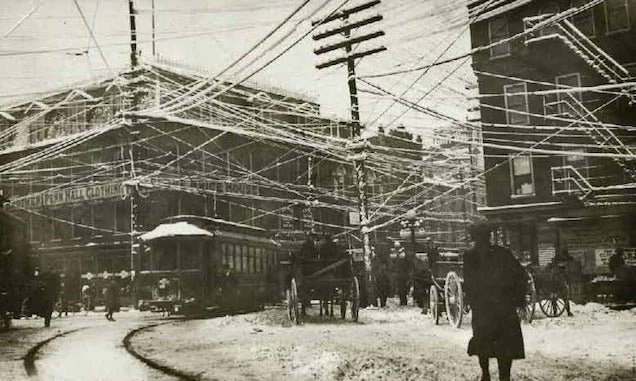
Electricity arrived as a novelty. Arc lamps on a few city streets. A spectacle at the 1893 World’s Fair. Something wealthy people installed partly to demonstrate that they could. For half a century the practical applications were limited to powering light bulbs. Between 1900 and 1930, the share of American factory power drawn from electricity climbed from roughly 10 percent to roughly 80 percent. For a good stretch of those thirty years, the skeptics had the better of the argument.
The real benefits required stringing wire across vast distances, planting ugly poles, and massive, generational investments in a technology few at the time knew how to truly harness and most considered indistinguishable from magic. Nobody living through those early years could have foreseen the ways that electrification would ultimately rewire our economy and lives. Nobody today could get through a Tuesday without it.
Sound familiar? That’s roughly where AI stands today. Narrow use cases, uneven results, enormous noise, and a public that keeps being told something historic is underway while seeing very little of it arrive in their own lives besides the onslaught of data centers popping up across the country. The skeptics are not being unreasonable. They are in the same shoes as people in 1905.
Infrastructure Worth Building
Electrification has allowed us to deliver power to places few could have imagined when the buildout began. It enables the modern world. The case for building digital infrastructure capacity is not that it will let us do our current work faster, although it will. The case is the third pile. The locality that never files the grant application. The disease with nobody assigned to it. The long list of things filed under unsolvable when the accurate word was unstaffed.
Which brings us back to the utility comparison. Nobody buys a utility. You build it, or you buy access to somebody else’s on their terms. That choice is being made right now, in interconnection queues and transformer orders and county hearings, mostly by people who aren’t thinking about the third pile at all.
For more than six decades we've helped communities and companies navigate economic transitions - and this is the big one.
Today, we work with towns, cities, megaregions, and digital-infrastructure developers on capacity and policy planning, community-engagement strategy, and the implementation playbooks that turn plans into live projects. The goal is always the same: help community and business leaders make informed decisions in a complicated world so they can act with confidence and on their own terms.